
Over the past few months, we have been mentioning that we had some exciting results, but that we were not yet able to disclose them. We’ve done so on our first and second annual reports, on social media, and on our webinars, whenever we talked about intellectual property.
Our strategy has been focused, first and foremost, on protecting the results of our work. These patents allow us to safeguard our technology and know-how —something that has required significant effort throughout the project. We want to ensure our innovations are secure before sharing them more widely, given their potential value for the future of pharmaceutical manufacturing.
So, after so much hype, the time has come! If you want to explore directly our three first IMPACTIVE patents, you can do so through Espacenet. But if you want a short explainer on them, with some additional context, keep on reading.
Method for automatically generating an optimised reaction plan and conducting a mechanochemical reaction
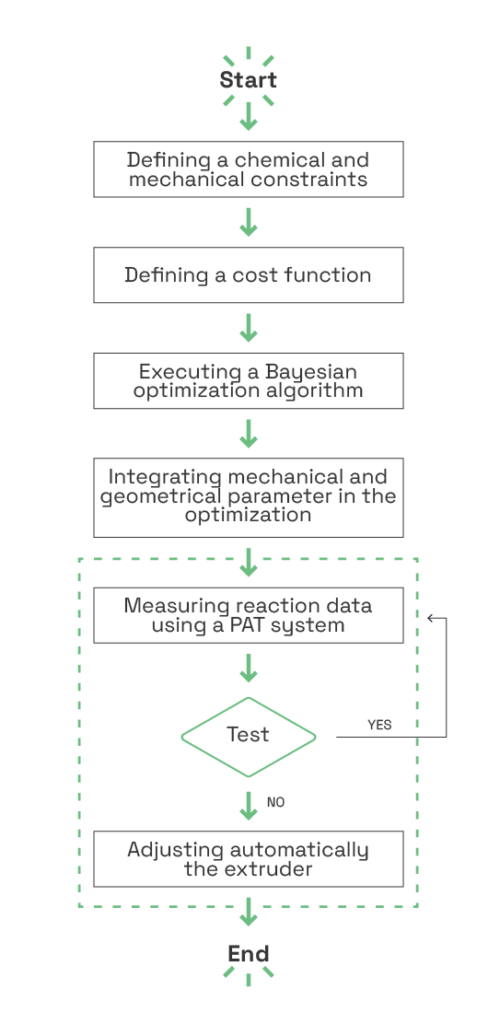
As anyone that has worked on a lab before knows, optimising reactions can be really tricky. Instead of relying on trial and error, the process defined in this patent automatically builds an optimised reaction plan for solid-state or liquid-assisted grinding, including in equipment such as extruders. The method involves defining chemical and mechanical constraints and initial conditions, establishing a cost function, and performing a multifactorial predictive analysis using a Bayesian optimisation algorithm without prior data to optimise the cost function.
Such method also takes into account mechanical and geometrical parameters directly related to the equipment’s components and integrates a process analytical technology (PAT) system to measure reaction data, providing in-line, real-time control and feedback. This enables the equipment to automatically and autonomously adjust parameters based on the measured reaction data. The advantages? A process that is more predictive and efficient, as well as far less dependent on manual tweaking.
Our project coordinator, the University of Montpellier, in France, is the inventor of this patent.
Use of a mechanical force in the process of preparation of Osimertinib
Osimertinib, an anticancer drug commercialised as Tagrisso, is a medication used to treat non-small-cell lung carcinomas with specific mutations. In particular, patients that have an abnormal EGFR gene. This patent relates to the use of mechanical force to generate a mechanochemical reaction in the preparation process of Osimertinib, or a pharmaceutically acceptable salt thereof. The process comprises five or six mechanochemically-activated steps, starting from 1-methylindole, and the synthesis is shorter than the commercial route in solution.
The process may also include an amidation step converting the above-mentioned triamine into osimertinib or its mesylate salt, with this step also being mechanochemical.
The inventors of this patent are the University of Montpellier and Radboud University, in The Netherlands.
Use of a mechanochemical method for selectively reducing nitrogen-containing compounds
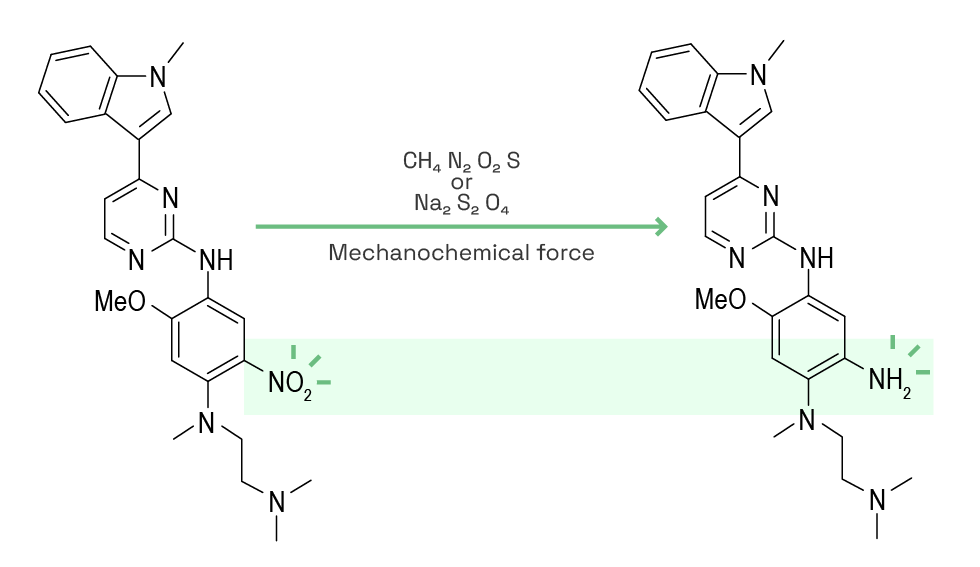
This patent relates to the use of a mechanochemical method in a process for the selective reduction to amines, free from molecular hydrogen (H₂). The used equipment for this transformation can be resonant acoustic mixer (RAM), a screw extruder, ball mills and bead mills. Unlike traditional catalytic hydrogenation processes, this mechanochemical nitro-to-amine reduction method enables pharmaceutical manufacturers to produce amine compounds while eliminating safety hazards, metal impurities, and complex solvent-based processes. It also delivers cost savings, higher productivity, reduced waste, and improved sustainability.
These three patents are an excellent example of the results of IMPACTIVE, and there are more to come! To know more, stay tuned to our social media (X and LinkedIn) and our newsletter.