Our publications
Want to stay up-to-date of all of our publications? Go to our Zenodo community!
Click to edit

Mechanochemical cocrystallization provides an efficient, solvent-minimized route for the production of pharmaceutical cocrystals. Although the small-scale synthesis of cocrystals is well established, strategies for the gradual scale-up to multigram and kilogram quantities remain limited. By systematically analyzing and comparing different scale-up stages, this study investigates the scale-up of paracetamol-oxalic acid (PCA-OXA) cocrystals using a range of milling technologies, including planetary ball mills, attritor mill, and drum mill. We aim to provide practical guidance on the capabilities and limitations of these devices and identify suitable milling parameters and strategies that ensure complete conversion and high product quality as batch sizes increase. In practice, planetary ball mills were used to prepare multigram quantities, while attritor mills generated hundred-gram batches under dry milling conditions. At the kilogram scale, drum milling required liquid-assisted grinding (LAG) with ethyl acetate to prevent caking and achieve full conversion. The results show that the gradual scale-up of PCA-OXA cocrystals is feasible when milling conditions and appropriate milling technologies are carefully selected, maintaining high yields and product quality across different scales. The findings contribute to a better understanding of the opportunities and limitations of mechanochemistry in pharmaceutical cocrystal development and offer guidance for the transition from laboratory-scale discovery to larger-scale production.
ACS Publications Organic Process Research & Development https://doi.org/10.1021/acs.oprd.6c00052
In this work, we study the dynamics of single balls inside the jars of the most common oscillating ball mills. Our methodology combines experimental measurements with numerical simulations. We use piezoelectric sensors to detect individual impacts and record long sequences of time intervals between consecutive impacts, which are used to characterize in detail the ball dynamics with and without powder in the jar. Experimental findings are used as the benchmark for numerical simulations, which reconstruct ball trajectories in three-dimensional jars, with flat or rounded ends, that undergo realistic oscillations. We systematically change the impact elasticity until experimental data are best reproduced by numerical data, achieving remarkable agreement. This suggests that calculations provide realistic estimates of impact frequencies, velocities and angles. We use these quantities to compare the performances of the different ball mills under working conditions. We test the reliability of our results by studying the kinetics of two mechanically induced transformations, namely the comminution of quartz powders and the dechlorination of chlorobenzene. The specific milling intensity, defined as the product between impact frequency and impact energy divided by the total mass of powder, is shown to be a scaling factor for transformation rates. Accordingly, the kinetic curves for transformations induced at different milling intensity collapse on a single curve when plotted versus the total energy delivered to powders. We created a website to give interested researchers the opportunity of running autonomously numerical simulations using our codes to deepen the insight into the mechanical processing conditions in their ball mills.
Elsevier Chemical Engineering Science https://doi.org/10.1016/j.ces.2026.124495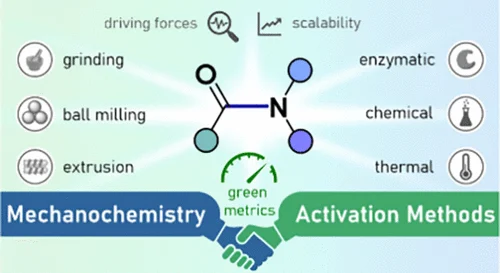
Mechanochemical methodologies are reshaping synthetic organic chemistry by enhancing practicality and reducing environmental impact. This review presents a comprehensive account of mechanochemical methods for amide bond formation, arguably the most developed and industrially relevant area within mechanochemical organic synthesis. Covering literature from early contributions to the present (September 2025), the review organization follows key substrate classes and methodological strategies: amide bond formation via coupling of carboxylic acids or their activated derivatives with amines (Section 2), followed by unconventional approaches (Section 3) employing carboxylic acid and amine surrogates, redox chemistry, rearrangements, and transition metal-mediated reactions leading to amide products through alternative bond-forming pathways. Mechanoenzymatic transformations are treated separately (Section 4), with stereochemistry-related issues, such as the preservation of enantiomeric purity, discussed in Section 5. Section 6 highlights the use of amide bond formation as a model system for probing mechanochemical driving forces. Special attention is given to scalability and successful scale-up examples, alignment with green chemistry principles, limitations, unexplored areas, and challenges requiring further development. This review is intended as an accessible and thorough resource for synthetic chemists in both academia and industry, including those newly exploring the field of mechanochemistry, and it provides practical guidance for process optimization and scale-up.
ACS Publications Chemical Reviews https://doi.org/10.1021/acs.chemrev.5c00534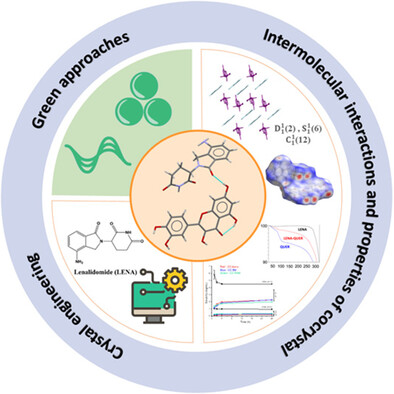
The modulation of physicochemical properties through the discovery of new solid forms has attracted significant interest in the pharmaceutical industry. Herein, a novel cocrystal of lenalidomide with quercetin was designed upon crystal engineering principles. Bearing in mind the importance of developing sustainable methods for the pharmaceutical industry, the synthesis of the novel cocrystals was explored by different mechanochemical approaches and slurry techniques for comparison purposes. Thus, the cocrystal was produced by liquid-assisted grinding in ball milling, liquid-assisted resonant acoustic mixing, and the slurry method. All the methods yielded the same final form with similar properties. From the point of view of properties enhancement, solubility studies showed that the cocrystal exhibited lower solubility than that of pure lenalidomide under simulated conditions of gastric and intestinal fluids, suggesting that the cocrystal may function as an extended-release form of lenalidomide. Furthermore, this cocrystal remained stable under accelerated stability conditions, indicating that atmospheric relative humidity does not represent a risk for the handling or storage of these compounds in the solid state.
Chemistry Europe Chemistry—Methods https://doi.org/10.1002/cmtd.70092


Our deliverables
Click to edit
-
 WP1Management and coordination
 -
 WP2Discontinuous and continuous processes
 -
 WP3Multi-component forms and formulation
 -
 WP4Kinetics and reaction mechanisms
 -
 WP5Scale up engineering
 -
 WP6Life cycle, safety and risk assessment
 -
 WP7Communication, dissemination and exploitation
We still haven’t produced any public deliverables in this Work Package. If you are interested in how things are going, please contact us!
We still haven’t produced any public deliverables in this Work Package. If you are interested in how things are going, please contact us!
We still haven’t produced any public deliverables in this Work Package. If you are interested in how things are going, please contact us!
We still haven’t produced any public deliverables in this Work Package. If you are interested in how things are going, please contact us!
We still haven’t produced any public deliverables in this Work Package. If you are interested in how things are going, please contact us!
We still haven’t produced any public deliverables in this Work Package. If you are interested in how things are going, please contact us!
 D7.2 Website and communication materials
A brief document explaining IMPACTIVE’s website and initial set of communication materials.
Our communication materials




Our current job offers
Our past job offers
📆 Deadline – 10/05/24
📍 Lisbon, Portugal 🇵🇹
💸1801€/month
We are looking for a Post-Doc who wants to the design, synthesis and characterization of new drug cocrystals, with a view to improving properties. Particular emphasis on X-ray diffraction in powders and single crystals.
📆 Deadline – 15/08/24
📍 Lisbon, Portugal 🇵🇹
💸+/- 1700 €/month plus food allowance
DES Solutio is hiring chemical engineers (or similar) with experience in modelling in Aspen Tech or Chemcad, preferably with experience in mechanochemistry or solid phase processing. The work can be carried out remotely, presently or in hybrid mode.
📆 Deadline – 15/09/24
📍 Louvain-la-Neuve, Belgium 🇧🇪
💸+/- 2200 €/month
We offer a scholarship position related to chiral induction using mechanochemical tools focusing specifically on the selected pharmaceutical target compounds of IMPACTIVE. The main focus will be placed on combining crystal engineering aspects with mechanochemistry.